Creativity
Find your artistic voice: a practice, not a discovery
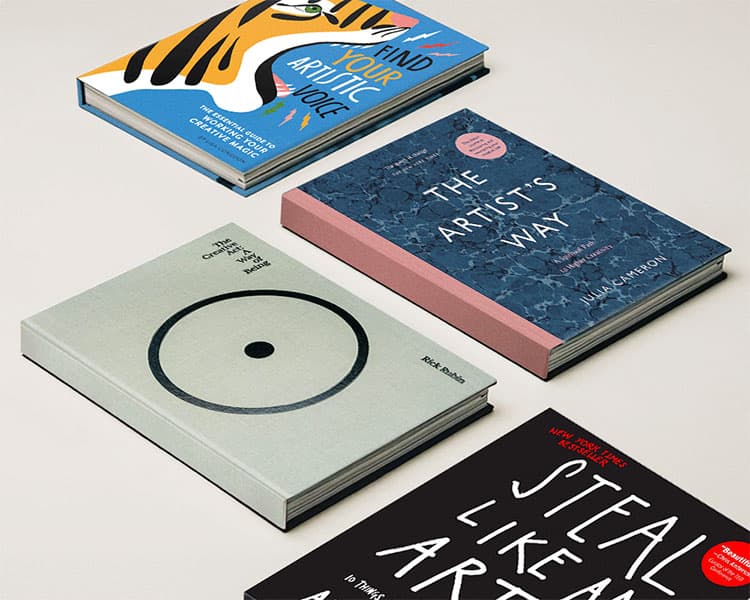
I’ve been re-reading Find Your Artistic Voice : The Essential Guide to Working Your Creative Magic by Lisa Congdon, a book I’ve recommended before . It pushed me to think about what actually changed my own work over the years, as opposed to what just sounded good in theory. Below are some key takeaways. To find your artistic voice, treat it as a practice, not a discovery Nobody finds their artistic voice in a single moment of clarity. It shows up gradually, through the accumulation of thousands of small decisions made across hundreds of pieces. Every sketch, every finished commission, every abandoned draft adds one more data point to a pattern you can only see in hindsight, never while you’re inside it. That means patience isn’t optional. Often, the version of your work you make this year won’t look like the version you make in five years, and comparing the two too early just gets in the way. Influence isn’t the enemy Early in my career, I copied compositions from illustrators I admired almost exactly, just to understand how they built an image. That phase wasn’t a detour from developing my own voice. It was the training that made one possible later. The shift happens when you stop copying a single influence and start filtering several through your own decisions at once. A color sensibility from one artist, a compositional habit from another, a subject matter you keep returning to on your own: none of it stays recognizable as someone else’s once it passes through enough of your own choices. Voice isn’t the absence of influence. It’s what’s left after you’ve metabolized enough of it that no single source is visible anymore. Constraints help more than freedom does An empty canvas and infinite options is one of the worst starting points for finding a distinct voice. Instead, I work better with a specific limitation: a two-color palette, a fixed composition rule, a self-imposed deadline. The constraint isn’t a creative sacrifice. It’s what forces a decision instead of an infinite hesitation between equally valid options. The mistakes that helped me find my artistic voice In fact, most of what I know about my own work came from pieces that didn’t turn out the way I wanted, not from the ones that did. A failed color combination taught me more about my own palette instincts than any successful piece did, because the failure forced me to articulate exactly what was wrong, which is a more precise kind of learning than “that worked.” Finding your artistic voice isn’t a destination you arrive at and then stop working toward. It’s closer to a moving target that gets a little clearer every time you show up and make something, whether or not that something turns out well.
Read moreA day in the life of an illustrator: my real routine
This is what a day in the life of an illustrator looks like from my studio. The scent of freshly brewed coffee, no sugar, fills the air as I settle in around 8 or 9 am. Once I have it, I’m ready. But before anything else, I grab my dog and we head to the park for a morning walk. Sunshine, fresh air, and a good audiobook. That’s how a day in the life of an illustrator starts for me: not at the desk, but outside, letting ideas arrive before I sit down to work on them. Getting organized: tools for a working illustrator’s day Once the walk is over, it’s all systems go! I rely heavily on Notion to keep my schedule organized (shoutout to their free version!). It’s my digital command center, holding project templates, notes, and a clear roadmap for the day. Meanwhile, the bulk of my day is dedicated to illustration projects. Occasionally, design requests pop up, keeping things interesting. I sprinkle in short breaks throughout the day, not just to rest but because coming back to the piece with fresh eyes each time makes it easier to catch whether it’s still matching what I had in mind. A quick stretch, a lunch break, and later on, another tiny cup of coffee before getting back to work. How I approach a new project When starting something new, I almost always begin with a mood board. I collect images from Pinterest, books, my own camera, anything that captures the visual territory I’m trying to reach. Then I compile everything in Photoshop, organized by layers, and start sketching over it to pull out a color palette . From there, depending on the project, I work in 2D or move into a clay render in 3D. For the 2D side, I’ve put together a roundup of free resources for illustrators worth bookmarking, pose reference, brush packs, color tools. I illuminate and texture that render with high quality materials, then often paint over the final version to add detail and push the piece further. I also keep a collection of free 3D textures on the site for materials. Plenty of projects still call for custom-built assets or premium libraries I pay for myself. Free resources don’t set the price of the work, they’re just one part of a much bigger process. And if the mood board process interests you, there’s a full walkthrough on how to build one . The second half of the day Around 6 or 7 pm I try to wrap up client work and leave room for personal projects. That might mean working on an illustration of my own, doing some freehand painting, or just switching off with a book, sci-fi film or some music. Video games are also a consistent source of visual input for me. I spend more time on Steam browsing promotional art , key art, and concept work than actually playing. The level of craft that goes into game visuals, the world-building, the character design, the way studios use color and lighting to build atmosphere, is genuinely worth studying. It’s a different corner of the illustration industry, and keeping an eye on it stops my own references from narrowing. What a day in the life of an illustrator is really about Music, paintings, books, films, games, all of it feeds the work, just not in a straight line. The structure of the day matters, but so does leaving room for the things that aren’t work and still end up shaping it anyway. That’s what it comes down to for me. Not just the hours at the desk, but staying curious enough that when I sit down to work, there’s something real behind it.
Read moreHow I reduce screen time as an artist
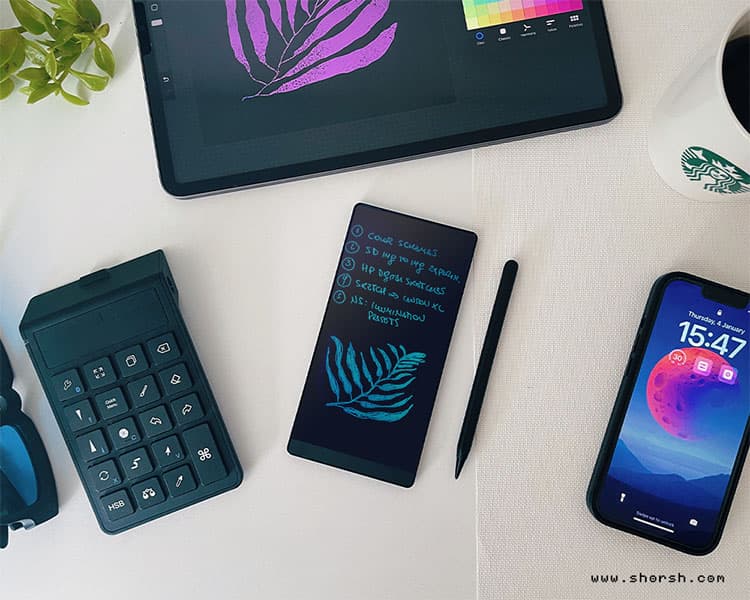
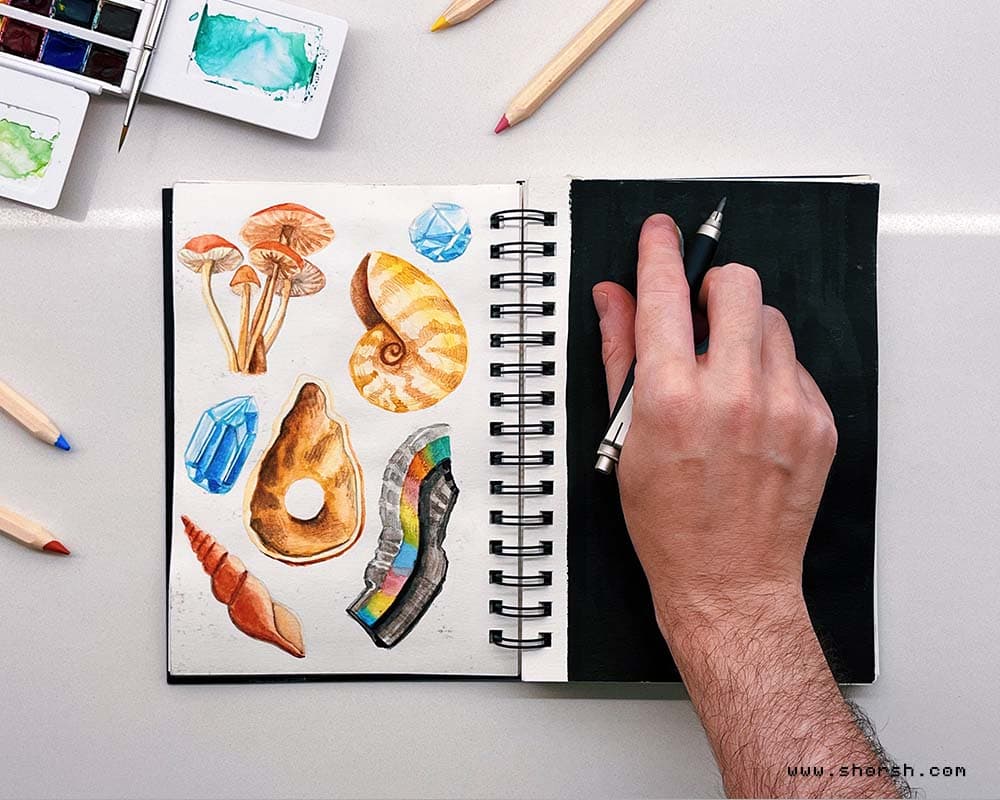
My phone and my iPad don’t do the same job. That’s how I reduce screen time as an artist without turning it into a chore. Specifically, the phone runs on an iOS focus profile that kills almost every notification. I already filtered out most of the apps built to track and interrupt me. Still, there’s less for the profile to block in the first place. Meanwhile, the iPad has no social apps and no feeds, nothing built to steal attention. I treat it like a second desk: a browser, a sculpting app, and a handful of sound tools. Why I split devices instead of just reducing screen time However, advice to reduce screen time as an artist never worked for me as a general rule. The real problem was never the screen, it was interruption. Social feeds, or any passive scroll, put you in what I think of as consumption mode. That mode is sneaky: it feels like you’re doing something, when really you’re making nothing at all. The gap between feeling busy and actually producing is the frustrating part. Production mode is the only way out. That’s the actual reason I reduce screen time as an artist. I read enough about creativity to notice a pattern. In fact, disconnecting and working with your hands is genuinely productive, not just relaxing. For instance, wasting a little time on purpose helps too. Analog and digital work also move at different speeds, and feel different too. Indeed, with your hands you’re touching the material; with a screen, you’re touching an interface between you and it. So that changes how you relate to the work, not just how fast you make it. An analog desk the phone never reaches My analog desk has watercolor paper, a cabinet with inks, pencils, watercolor, gouache, and acrylics. Next to it is a small reference library: art books by John Harris, artist monographs from Taschen. Besides those, a few are on color theory, others built around traditional-media exercises. I’ll sometimes bring the iPad to that table for digital reference. The phone stays somewhere else entirely. No cheap dopamine at the drawing table. The iPad as a second, parallel work hub The iPad runs its own small set of tools, separate from the computer entirely. Procreate, mostly for 3D sculpting, plus Koala Sampler, GarageBand, and a few synths and drum machines. The sound tools exist because motion graphics projects sometimes need original loops or chimes. Not stock audio. For example, my last project with Klydoclock, a new collection of animated watchfaces, used sounds I built myself. Chimes included, all on that same iPad. What changes once I actually reduce screen time Once nothing external can interrupt, something in the attention itself shifts. Eventually, you stop noticing time passing, and the work absorbs whatever you’d normally spend on checking a phone. A lot of my bigger projects started on paper this way. They only got bigger once I brought technology into them. Other times I go straight to the machine. But I still reach for materials when I want a real problem, not a simulated one. There’s no undo button on watercolor paper. Solving those problems by hand turns out to be more fun, not less. It’s also more satisfying, since the work stays physical from start to finish. Holding a finished piece you made with your own hands hits differently than opening a finished file. After all, that’s part of why I reduce screen time as an artist in the first place. If you’re curious how the hands-on side of this works day to day, I’ve written about it elsewhere. Two posts worth starting with: protecting that time and a few small rituals that keep it going. Sketchbook habits fill a similar role for me, on the days I never open the iPad at all.
Read moreProtecting your creative time: the habits that stuck
Protecting your creative time seems simple until a client email, three social media notifications, and an invoice all show up before ten in the morning. Most advice about creative productivity assumes you have one job. Freelance illustration means juggling several at once, and the actual challenge isn’t motivation, it’s keeping the different parts of the day from bleeding into each other. Batching, but only for the boring parts Task switching has a real cost. Answering an email, then sketching for ten minutes, then checking Instagram, then back to sketching, drains more mental energy than doing any one of those things for an extended stretch. I batch the administrative side of the day: emails, invoicing, social media, all handled in one block instead of scattered throughout. That single change freed up more usable creative time than anything else I’ve tried. Why I stopped using timers to protect my creative time The Pomodoro technique works well for administrative tasks, twenty-five minutes on, five off, but I’ve found it actively works against deep creative focus. A timer going off mid-sketch breaks a kind of concentration that takes real effort to rebuild. I still use short timed sprints for emails and invoicing. For actual drawing or painting, I protect open-ended blocks instead, with no timer counting down in the background. A ritual that has nothing to do with discipline My own ritual is simple: music on, humidifier running, then I organize whatever materials I need for the session. By the time that’s done, I’m already in the mood to start. It’s not about willpower. It’s about giving my brain a consistent, repeatable signal that this specific stretch of time belongs to the work and nothing else. Saying no protects the time before it gets protected None of the habits above matter if the calendar is already full of commitments that don’t need to be there. Saying no to requests that don’t align with actual priorities is what makes room for any of this in the first place. It’s the least glamorous part of protecting creative time, and also the one that makes the biggest difference.
Read moreSmall creative rituals that actually hold up
Small creative rituals work better than dramatic resolutions to “be more creative.” The habits that actually stick tend to be small enough that skipping them once doesn’t derail the whole practice. A five-minute entry point: the smallest creative ritual that works Waiting to feel inspired before starting is a losing strategy. A small, repeatable action, opening the sketchbook, putting on a specific playlist, putting your favorite fragrance on your scent diffuser, works better because it doesn’t depend on motivation showing up first. The ritual creates the mood, not the other way around. Feed the work with things that aren’t the work Reading something unrelated to your field , wandering through a museum you’ve never visited, taking a class in a skill that makes you nervous: none of this looks productive in the moment. Often, it’s where a lot of unexpected material actually comes from. Creative work that only draws from creative sources tends to flatten out over time. Let bad days be part of your small creative rituals Some stretches produce nothing worth keeping. In fact, that’s not a failure of the ritual. It’s the ritual working as intended over a long enough timeline. A practice that only counts the good days isn’t sustainable, because most days aren’t good days. Share the work before it feels finished Talking to other people about work in progress, not just finished pieces, tends to surface ideas that solitary practice doesn’t reach. It’s a small ritual on its own: showing something unresolved to someone else on purpose, on a regular basis, instead of waiting until it’s polished enough to be safe. Generally, the rituals that last aren’t the ones that feel most inspiring on day one. They’re the ones small enough that doing them half-heartedly on a bad week still counts.
Read moreWasting time boosts creativity: how to use it on purpose
Wasting time boosts creativity more reliably than staring at a blank page ever has for me. It happens almost every time before I start a big project: I lose myself doodling something unrelated, scrolling for reference images I don’t need yet, or just sitting there doing nothing in particular. The deadline is right there, and instead of working toward it directly, I drift. And then, somewhere in the middle of that drifting, the actual idea shows up. A half-formed concept clicks into place, or a solution to a problem I hadn’t consciously been thinking about just appears. The deadline stops feeling like a threat the moment that happens. Why wasting time boosts creativity, and it isn’t just me making excuses There’s a name for this: researchers call it the Creative Procrastination Paradox. Daydreaming, mind-wandering, and plain boredom turn out to be productive states, not wasted ones. When your mind isn’t locked onto a specific task, it makes connections between things that a focused brain would never put together, because focus is, by definition, narrowing. I’m not arguing for abandoning deadlines altogether. There’s a real difference between productive drifting and just avoiding the work entirely, and the line between them is worth being honest with yourself about. What this actually looks like in practice The drifting itself isn’t the useful part. What matters is what you do with it. I keep a sketchbook nearby specifically for the ideas that show up during these unfocused stretches, because if I don’t write them down immediately, they disappear as quickly as they arrived. Half of what ends up in a finished piece started as a note scrawled during a moment I would have called “wasting time” a few years ago. The other thing that changed how I use this is scheduling it on purpose instead of feeling guilty about it. Fifteen or twenty minutes of deliberately doing nothing, no phone, no reference hunting, just sitting with a problem. It produces better results for me than pushing through another hour at the desk when nothing is coming. Why wasting time boosts creativity better than forcing focus Deadlines create urgency, but urgency and creativity don’t actually run on the same fuel. Urgency narrows your options down to the first workable solution. Wandering opens them back up. The trick isn’t choosing one over the other permanently, it’s knowing which state a given problem actually needs, and giving yourself permission to be in the unproductive one when that’s what the problem calls for. That’s the actual mechanism behind why wasting time boosts creativity: it’s not magic, it’s just a different cognitive mode.
Read moreList-making for creativity: turning chaos into direction
List-making for creativity sounds like a contradiction. Creativity is supposed to be loose, associative, resistant to structure. But in practice, the opposite is true: a list is one of the fastest ways to get a chaotic idea out of your head and into a form you can actually work with. I make lists constantly, for almost every part of my process. Not as a productivity system, but as a way to think. What list-making for creativity actually looks like in my process Project ideas go in a running list I add to whenever something occurs to me, usually completely unrelated to whatever I’m working on at the time. I list visual references before I ever open a moodboard tool: artists, films, color combinations, textures, anything that comes to mind when I think about the mood I’m chasing. I turn client feedback into a list immediately after a call, before the nuance of what they actually meant gets lost in my own interpretation of it. Even naming ideas for a project or a series start as a messy list of ten or fifteen options before any of them get refined. None of these lists are neat. Half the items get crossed out. That’s fine. The point isn’t a clean final product, it’s capturing the raw material before it disappears. Why list-making for creativity beats a paragraph A paragraph forces you to commit to a sequence and a relationship between ideas before you’re ready to. A list doesn’t ask for that. Each item can exist on its own, unranked, unconnected to the ones around it, and that’s exactly what a first pass at a creative problem needs. This matters most in the early, messy part of a project, before you know which idea is actually good. Prose invites you to justify an idea as you write it down. A list just lets you record it and move to the next one. That difference sounds small, but it changes how much you’re willing to write down in the first place. Turning a list into direction A list of twenty scattered ideas isn’t useful by itself. The value comes from what happens after: going back through it and noticing which three or four items keep pulling your attention. Those are usually the ones worth pursuing, not because they’re objectively the best, but because something in them is still generating interest after the initial burst of writing them down. I treat my project list this way. Most entries sit there for months, sometimes years, before I come back to one and realize it’s finally the right moment for it. The list isn’t a to-do queue. It’s more like compost: most of it just needs time. The list-making habit that actually matters The specific format doesn’t matter much. Notion, a paper notebook, the notes app on your phone: any of them work as long as you actually use it consistently. What matters is treating the list as something you add to constantly, not something you write once and revisit occasionally. List-making for creativity isn’t about forcing order onto something that resists it. It’s about giving your ideas somewhere to sit until you’re ready to look at them again.
Read moreDrawing to think: the hands that shape ideas
“To draw is to sharpen an idea, drawing is the precision of thought” Henri Matisse I think about that Matisse line often, mostly because it’s true in a way that’s easy to forget. Drawing isn’t just sketching lines and shapes. Still, it’s a way into clarity that thinking alone doesn’t get you to. Here’s what happens when you draw to think, and how to use that connection between hand and mind on purpose. Drawing to think starts with hand and mind working together When pencil meets paper, or stylus meets tablet, both the physical and the cognitive sides engage at once. Drawing something accurately forces real observation, the kind that notices details and nuances most people scroll straight past. Eventually, that habit of close looking carries over. It makes for more careful thinking in general, not just at the drawing table. Every drawing is also a string of small decisions about proportion, perspective, and composition. That’s really just problem-solving in disguise. Also, considering different angles on paper is good practice for considering different angles on a problem later. Turning abstract ideas into something you can see In fact, drawing is also the bridge between an idea in your head and something you can point at. It gives shape to whatever was abstract a moment ago. That makes it a lot easier to work with. That’s usually the moment an unconventional idea stops sounding far-fetched and starts looking like something that could genuinely work. The flow state drawing gets you into Drawing regularly tends to pull you into a state where time stops mattering. The mind stays fully on the task, nowhere else. That state does more than sharpen the work. It also puts you back in touch with your own thoughts and feelings. It’s the same mindful state I try to protect from screens the rest of the day. Drawing as its own language Drawing works as a form of communication too, a way to say something that’s genuinely hard to put into words. Generally, translating a thought or a feeling into something visual makes the expression feel more honest, less filtered. Matisse’s point holds for anyone, not just artists. Drawing sharpens thinking no matter who’s holding the pencil. How to build a drawing-to-think habit Keep a sketchbook nearby , always, so you can capture an idea the moment it shows up. It doesn’t need to be anything special. A plain notebook works, and so does the back of whatever’s already lying around. Draw without expecting it to look good. Treat the page like nobody’s watching, because usually nobody is. Quality matters less than quantity at the start. Sketch constantly and let the pencil move before the doubt catches up. With enough practice, drawing to think stops being a tool you reach for occasionally and turns into how you think.
Read moreBooks for creative block: five that actually help when you’re stuck
Books for creative block are easy to find and mostly useless. Most just repackage “believe in yourself” into 200 pages. These five books for creative block are the exceptions, the ones that gave me something to actually do instead of something to feel. The Creative Cure, by Jacob Nordby This one deals directly with creative paralysis rather than talking around it. Nordby treats the block as something with identifiable causes, not a mysterious curse, and the exercises are specific enough to actually try instead of just nodding along with. Thinking, Fast and Slow, by Daniel Kahneman Not a creativity book at all, but it explains why blocks happen better than most books that claim to be about creativity. A lot of creative paralysis comes down to specific cognitive biases: overvaluing the first idea, catastrophizing a bad draft, anchoring too hard on what “should” work. Understanding the mechanism makes it easier to catch in the moment. The Practice of Groundness, by Brad Stulberg Blocks are often just racing thoughts and scattered attention wearing a creative disguise. Stulberg’s approach to mental clarity isn’t creativity-specific, but the techniques translate directly. Calming the noise first tends to matter more than any creative exercise applied on top of it. Your Inner Critic Is a Big Jerk, by Danielle Krysa Most blocks are really the inner critic getting louder than the actual work. Krysa’s book is specifically useful because it treats self-doubt as a manageable, almost comic character instead of an unbeatable force. That makes it easier to work around instead of freezing in front of it. Caffeine for the Creative Mind, by Stefan Mumaw and Wendy Lee Oldfield When the problem isn’t the mindset but literally not knowing where to start, this book is pure mechanism. Prompts and quick exercises meant to get a pencil moving in the next five minutes. Useful specifically for the days when analysis isn’t what’s needed, just momentum. These five books for creative block solve different versions of the same problem. Nordby and Krysa work on the emotional block. Kahneman and Stulberg work on the mental one. Mumaw and Oldfield just get you moving when neither of the others quite applies.
Read moreBooks on the creative process: five for the long game
Books on the creative process tend to fall into two categories: the ones that motivate for a week, and the ones that actually change how you think about the work. Generally, these five belong to the second category. I’ve reread parts of each one more than once, which is the real test. The Creative Act: A Way of Being, by Rick Rubin This is the book on the creative process I recommend first. Rubin brings decades as a music producer to a book that isn’t really about music at all. It’s closer to a set of principles for paying attention, treating every decision in the process as worth noticing rather than rushing past. Dense in places, but the kind of density that rewards rereading a section months apart. Find Your Artistic Voice, by Lisa Congdon In fact, Congdon’s core argument is that you don’t discover voice in a single moment, you accumulate it through repetition and honest mistakes. That idea alone reshaped how I think about my own process , specifically the chapters on filtering influence instead of avoiding it entirely. Steal Like an Artist, by Austin Kleon Kleon’s central claim, that originality is really just well-digested influence, is uncomfortable the first time you read it and obviously true the second. Still, the book is short enough to reread in an afternoon, and it holds up better on a second pass than most books twice its length. The Artist’s Way, by Julia Cameron Some of Cameron’s language reads dated now. But the underlying structure, specifically the practice of daily pages, is one of the few habits from any creativity book I’ve actually kept doing for years. The exercises work less as inspiration and more as maintenance. Big Magic, by Elizabeth Gilbert Gilbert’s argument about fear coexisting with creative work rather than blocking it is more useful than most advice about “overcoming” fear entirely. The book treats fear as a permanent passenger, not an obstacle to defeat once and move past. None of these five books on the creative process are quick fixes, which is exactly why they’ve lasted on my shelf longer than the books that promised faster results.
Read moreHow to overcome creative block: 10 tips that actually work
How to overcome creative block is something every artist figures out on their own, usually in the middle of a project they care about. You sit down to work, open your file, and nothing comes. The cursor blinks. The canvas stays white. I’ve been there more times than I care to count. These are the strategies that have actually helped me get moving again. Go somewhere new when creative block hits Staying at your desk and pushing harder rarely works. Your environment shapes your mental state more than you’d expect. Go to a museum, a park, a bookstore in a neighborhood you don’t usually visit. You’re not hunting for inspiration in some grand sense, just novelty. A different set of visual inputs is often enough to break the loop. Stop and actually rest Creative blocks are often just depletion. Resting is not the same as procrastinating. Take a day away from making things, and do something that has nothing to do with your field. Spend time with people who don’t care about your work. The pressure to always be producing is one of the main reasons blocks happen. Sometimes the only real solution is to stop fighting them. Get outside feedback When you’ve been staring at your own work for too long, you lose the ability to see it clearly. Reaching out to a peer or a mentor can shift things fast. What you need is a different pair of eyes, not reassurance. Hearing someone else describe what they see in your unfinished piece often shows you the next step. Use a constraint to break out of the block One of the most effective things I do when I’m stuck is give myself an arbitrary rule. Work only in two colors, or finish something in under 30 minutes. The goal is not to produce something great. It’s to make the task feel small and specific instead of open and infinite, so your inner critic has less to work with. Make something bad to break the creative block Perfectionism is usually the real block. The fear of making something bad keeps you from making anything at all. So make something bad deliberately. Sketch something ugly, paint over a finished piece, write the worst possible version of whatever you’re avoiding. Getting your hands moving again matters more than the quality of what you produce while doing it. Change your workspace This one is simple and it works. Move to a different room, work outside, rearrange your desk. The physical space you associate with being stuck can keep you stuck. A fresh location often resets things faster than any technique will. Sit with the discomfort before reaching for a solution Before jumping into a creative exercise or reaching for your phone, try sitting quietly for a few minutes and doing nothing. Not formal meditation, just noticing what’s actually happening. Sometimes the block is anxiety about a specific project. Sometimes it’s fatigue, or something that has nothing to do with work at all. Identifying the actual cause tends to be more useful than working around it. Learn something outside your usual field This is one I come back to often. Trying a different software, a physical technique you’ve never used, or something with no obvious connection to your work tends to produce the most interesting cross-contamination. The ideas you bring back from unfamiliar territory are often the ones your audience hasn’t seen, because they came from somewhere your audience hasn’t been looking. Inject randomness into the process Open a random color palette generator and work with whatever it gives you. Pick a random word and make a piece that responds to it somehow. Alternatively, flip your reference image upside down and work from that. The point is to interrupt the habits that are keeping you in one mode. Once you break the pattern, the block usually loses its grip. Celebrate finishing, not just succeeding Finishing a sketch you’re not proud of is still finishing. Creative momentum comes from small completions, not from occasional big wins. Every time you close a file and have something to show for the session, however rough, you’re reinforcing the habit of making. That habit matters a lot when the next block arrives. Blocks are part of the work. I’ve never met an artist who doesn’t get stuck. The difference, in my experience, is having enough options that you know what to try next the next time creative block hits instead of just waiting it out.
Read more