
MC Escher paintings: the logic behind the impossible

Escher’s illusions aren’t magic tricks. Each one exploits a specific gap between local logic and global consistency. Here’s how five of his most famous prints actually pull it off.
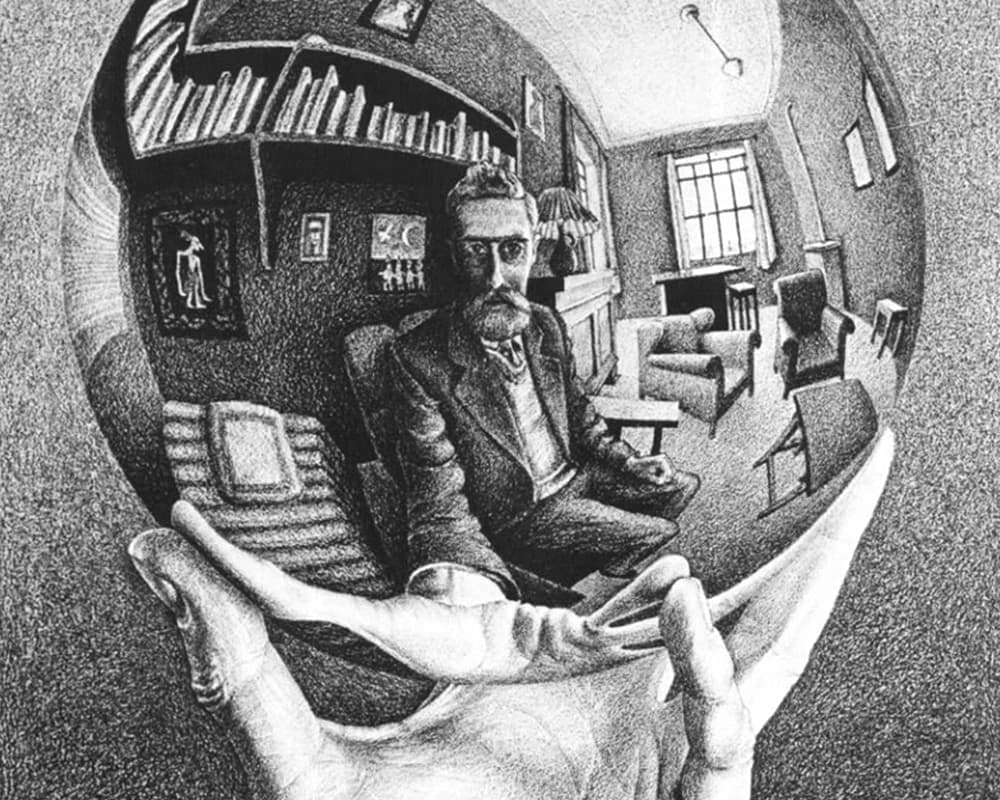
MC Escher paintings look like optical tricks at first glance, but the trick is never the point. Escher trained as a graphic artist, not a mathematician, and what makes his work last is that he builds every impossible structure with the same rigor as a real one. The geometry is wrong, but it’s wrong in a way that’s internally consistent, which is exactly what makes it so hard to look away from.
I’ve been drawn to MC Escher’s paintings since my first years as a student, and it’s stayed influential in how I think about composition ever since.
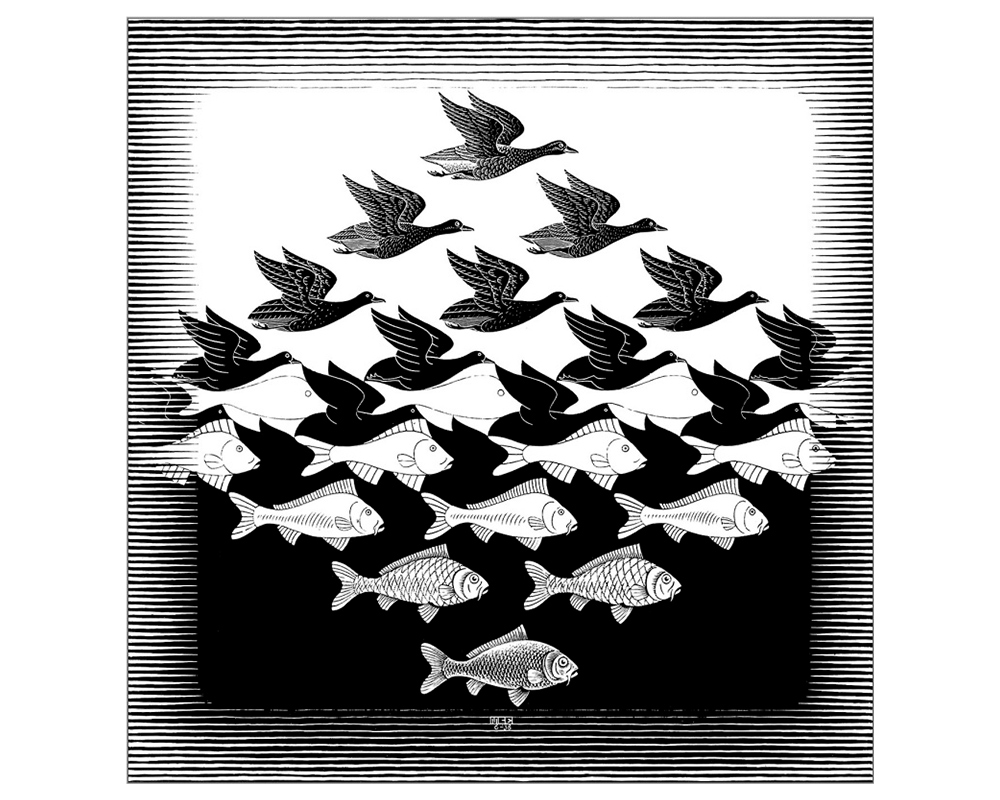
Sky and Water I: an MC Escher painting where the illusion lives in the gaps
In “Sky and Water I” (1938), birds at the top of the composition gradually become fish at the bottom, using the same tessellated shape the entire way through. Nothing about any single bird or fish is impossible. The trick is in the transition: your eye can’t decide at what exact point a bird stopped being a bird, so it experiences the whole print as a continuous transformation rather than two separate images. That’s the actual mechanism behind most of Escher’s tessellation work, ambiguity placed exactly where your visual system expects a clean boundary.
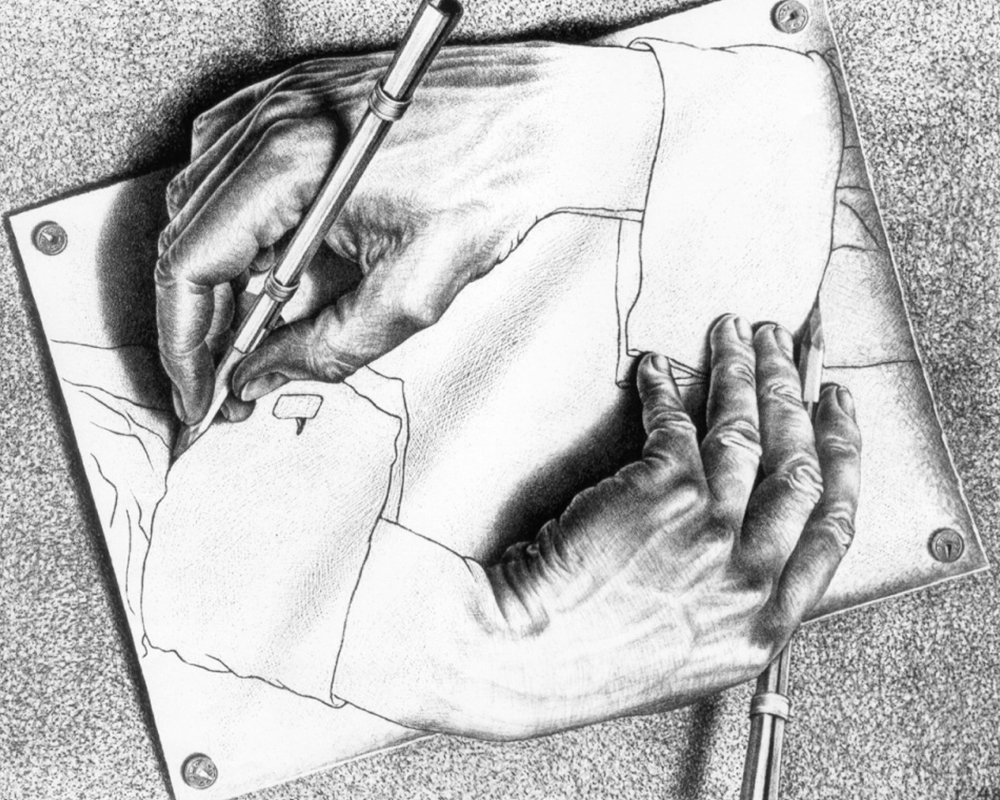
Drawing Hands: a loop with no starting point
“Drawing Hands” (1948) shows two hands, each drawing the other into existence on the same sheet of paper. There’s no way to determine which hand came first, because the image doesn’t give you an entry point outside the loop. That’s the real subject of the piece: not the technical skill of the rendering, which is considerable, but the fact that the logic of cause and effect simply has nowhere to attach.
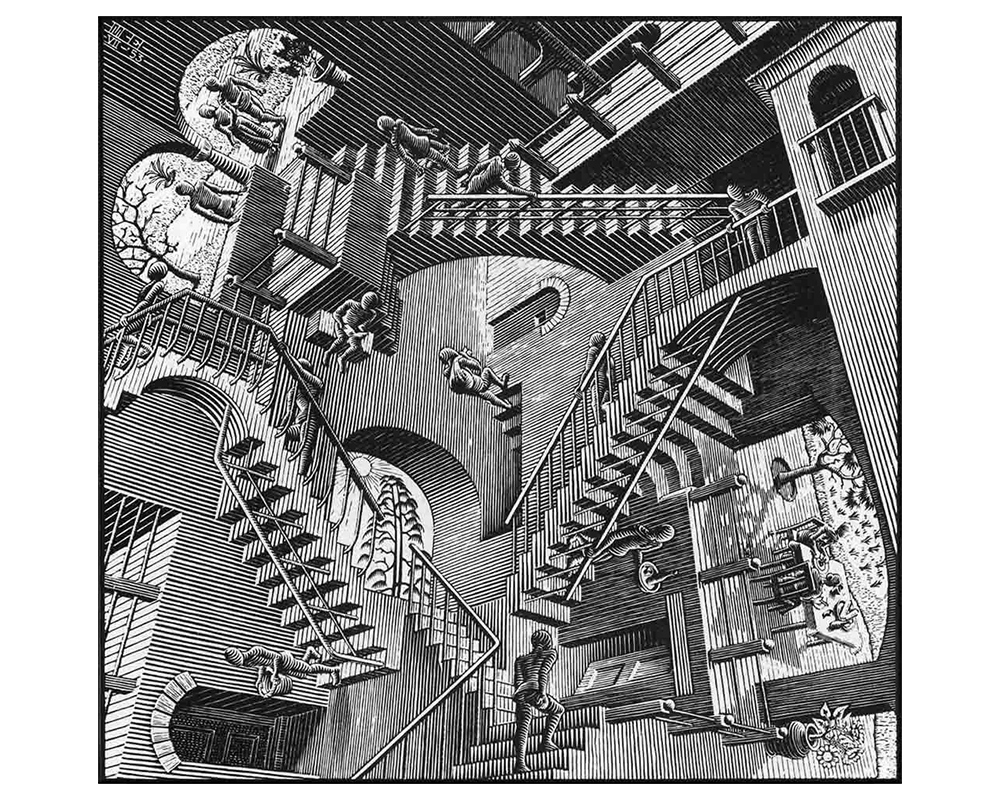
Relativity: how this MC Escher painting builds three gravities
“Relativity” (1953) works by giving each staircase and doorway a locally consistent gravity, then connecting them into a single structure where those gravities contradict each other. A figure walking normally on one staircase is walking sideways relative to a figure on the staircase next to it. Escher never breaks the internal logic of any individual path. He only breaks the assumption that all paths in a building share the same downward direction.
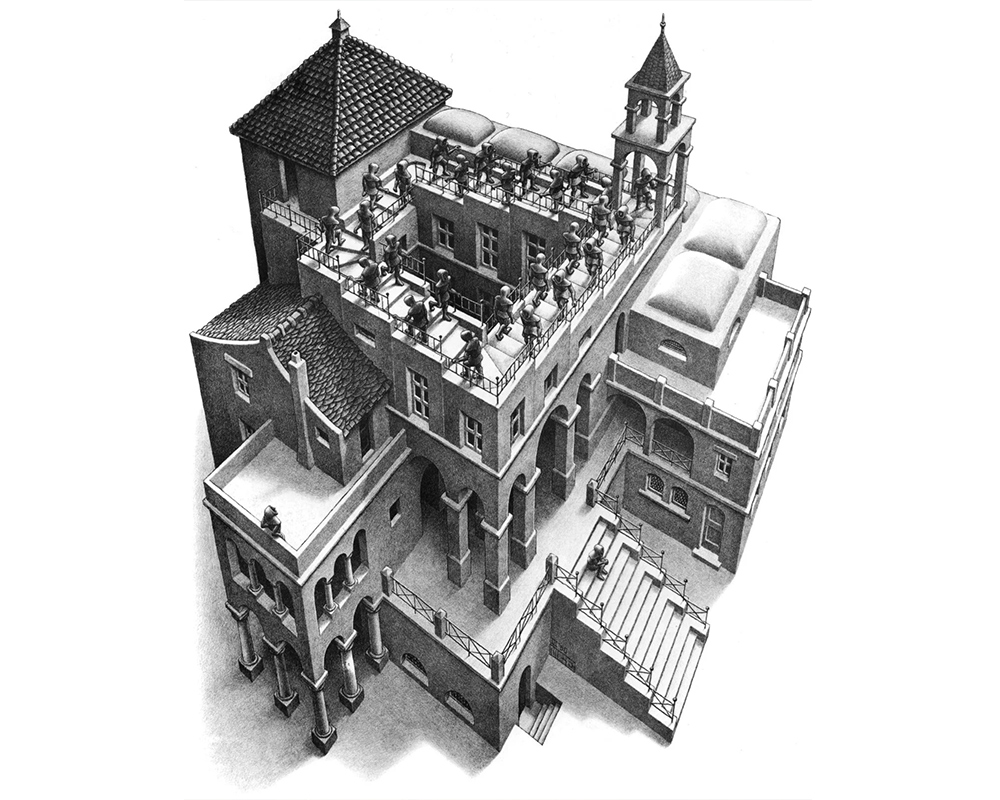
Ascending and Descending: the staircase that goes nowhere
“Ascending and Descending” (1960) uses the Penrose stairs as its foundation, a loop of four staircases that each appear to climb, while together forming a closed rectangle that never actually gains height. Figures walk the loop endlessly, always ascending, never arriving anywhere. The illusion depends entirely on being viewed from one fixed angle. Move the camera and the impossible structure falls apart instantly, which is exactly what makes the flat, static nature of a print the ideal medium for it.
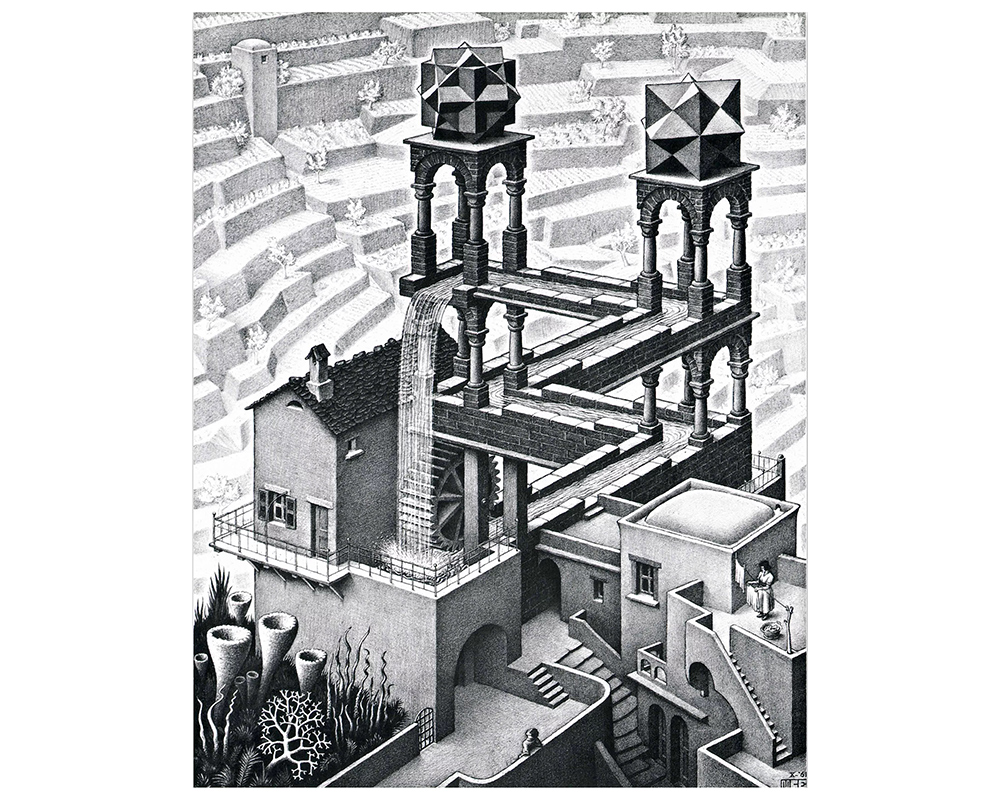
Waterfall: causality folded into a single object
In “Waterfall” (1961), water falls, turns a wheel, then travels back uphill through a series of aqueducts to fall again. Escher hides the impossibility inside a structure that looks like ordinary architecture: columns, beams, a stone channel. The perpetual motion isn’t the interesting part. What’s interesting is how plausible each individual segment of the structure looks in isolation.
What actually holds up in MC Escher’s paintings
None of these prints rely on trickery in the way a magic trick does. They rely on exploiting a gap between local logic and global consistency, and doing it with enough craft that the gap isn’t visible until you go looking for it. That combination, mathematical rigor plus genuine, unforced imagination, is why MC Escher paintings still get studied by architects, game designers, and illustrators who have nothing to do with fine art.