
Hieronymus Bosch paintings: seven curiosities

Bosch painted hybrid creatures and moral allegories two centuries before anyone called it surrealism. Here’s what makes five of his strangest works still unsettling today.
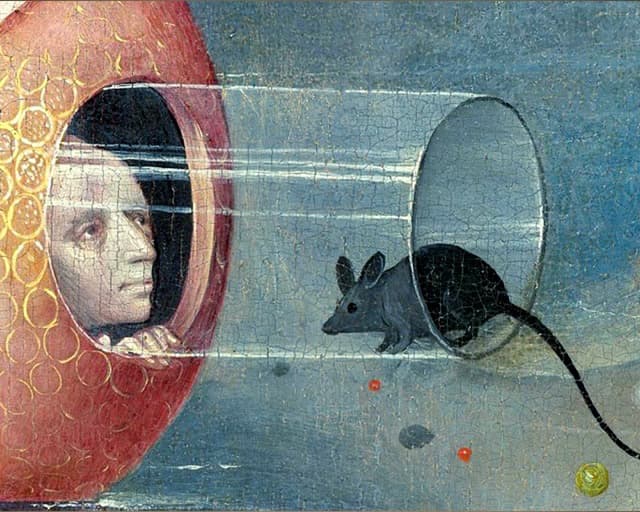
Hieronymus Bosch paintings have captivated me for a long time. It’s as if he dipped his brush into a cauldron of dreams and nightmares, then rendered every detail with the patience of a much calmer painter. Hieronymus Bosch paintings look like nothing else being made in Europe at the time, and five centuries later they still don’t look like anything else.
He painted before anyone had a word for surrealism
Bosch was born around 1450 in ‘s-Hertogenbosch, in the Duchy of Brabant, now the southern Netherlands, and worked through a period thick with religious anxiety and folk superstition. In fact, nothing in that context explains what he actually painted. His work looks like a direct transmission from somewhere else entirely, four hundred years before Dalí or Magritte gave that impulse a name.
Hieronymus Bosch paintings: the Garden of Earthly Delights
“The Garden of Earthly Delights” (c. 1490 to 1510) is the clearest case. The left panel shows Eden, the right shows Hell, and the center panel, the one everyone remembers, is packed with nude figures, oversized fruit, and structures that look grown rather than built. It isn’t one scene. It’s an argument about paradise, temptation, and punishment laid out across three panels, dense enough that art historians are still arguing over what half of it means.

His creatures never repeat
In “The Temptation of Saint Anthony,” Bosch subjects the saint to a parade of tormentors: hybrid animals, half-human figures, things with no clear taxonomy at all. What’s notable is that across his whole surviving output, the inventions almost never repeat. Most artists working with invented creatures fall back on a small set of motifs. Instead, Bosch seems to have generated an entirely new vocabulary of monsters for every commission.

The everyday symbols hidden in Hieronymus Bosch paintings masterpieces:
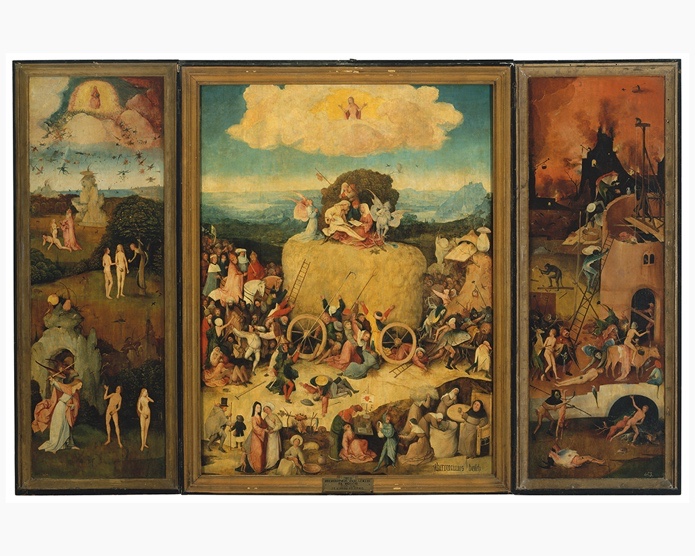
“The Haywain Triptych” (c. 1510-1516) uses something deceptively ordinary, a cart loaded with hay, as its central image. In the period, hay symbolized worthless material goods that people fought over anyway. Bosch builds an entire moral scene around a wagon nobody would look at twice. That’s exactly the kind of symbolic sleight of hand that runs through his whole body of work: the meaning hides inside the mundane, not the monstrous.
His judgment scenes are more disturbing than his monsters
“The Last Judgement” (c. 1482) puts the grotesque creatures to work in service of something bleaker than fantasy. The panel stages the separation of the saved from the damned, and Bosch’s punishments for the damned are inventive in a way that’s genuinely upsetting rather than merely strange. It’s the clearest evidence that Bosch’s imagination wasn’t decorative. Rather, it was doing theological work.

Five centuries of arguing hasn’t settled anything
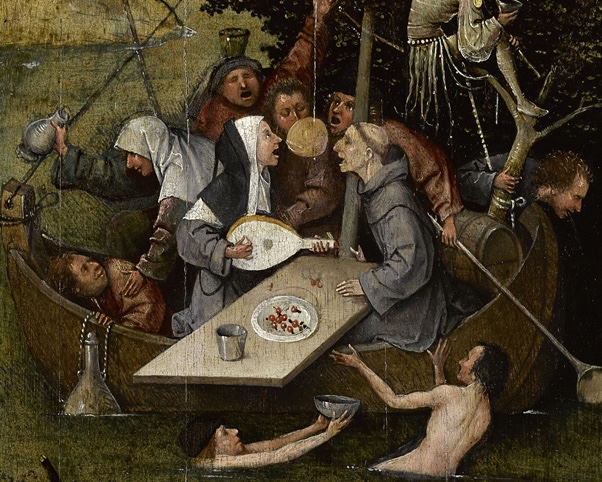
“The Ship of Fools” (c. 1490-1500) shows a boatload of clergy and commoners drinking and carousing while adrift, presumably headed nowhere useful. Historians still debate what exactly Bosch was satirizing, the clergy, human folly in general, or something more specific to Brabant in his lifetime. That the debate hasn’t resolved after five hundred years says something about how deliberately layered his symbolism actually was.
Why Hieronymus Bosch paintings still work today
What holds up across all five of these paintings isn’t the shock value of the creatures. It’s that Bosch built worlds complete enough to survive without their original context. You don’t need to know fifteenth-century Dutch moralizing to feel unsettled standing in front of “The Garden of Earthly Delights.” The strangeness does its own work, the same way it did in 1500.