
Salvador Dalí surrealism: the vision that persists
Dalí didn’t just paint dreams. He rendered them with the precision of a Dutch Old Master. Here’s what makes his surrealism still impossible to look away from.
share this!
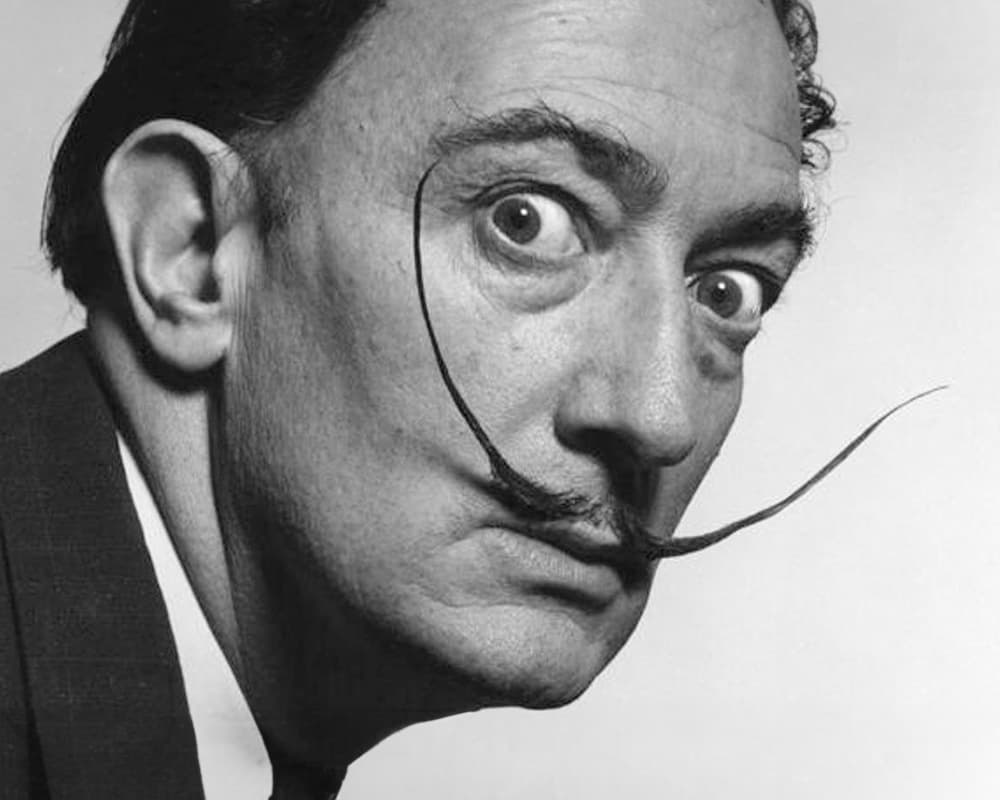
Salvador Dalí surrealism is, in many ways, the version of surrealism most people picture when they hear the word. The melting clocks. The vast, bleached landscapes. Figures that are human-shaped but wrong in some way you can’t locate. Born in Catalonia in 1904, Dalí came to define a movement that was already underway, then pushed it somewhere no one else had thought to go.
I’ve been drawn to his work since I was a student, and the pull hasn’t diminished. There’s something in the way he combines technical precision with complete logical impossibility that still strikes me as one of the hardest things to pull off in visual art.
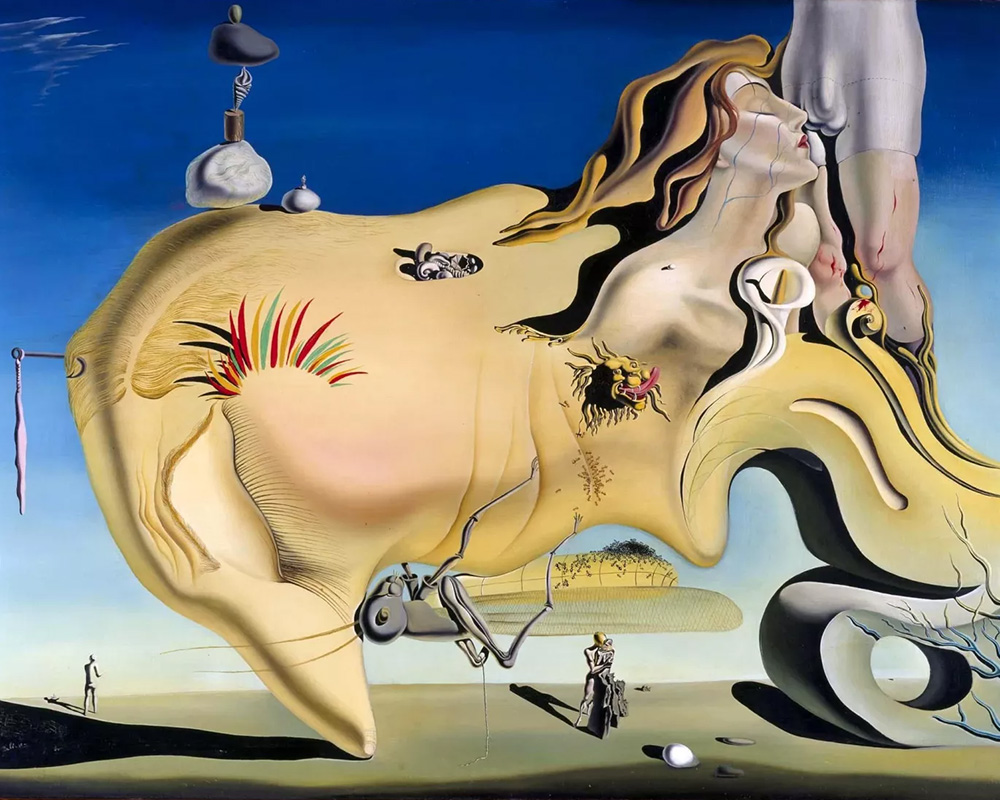
“The Great Masturbator”, painted in 1929, is where many of those obsessions first appear in concentrated form. The central image is based on a rock formation at Cap de Creus on the Catalan coast, which Dalí read as a face with its nose pressed to the ground. From that starting point the painting accumulates: ants, a grasshopper, a lion’s head, a female figure emerging from the profile, a bleeding knee. The elements don’t form a narrative so much as a personal inventory of fears and desires rendered with the same clinical precision he would use for everything else. It’s autobiographical in a way that most painting isn’t, not because it tells a story but because it shows the inside of a specific mind at a specific moment.
Not irrational: what Salvador Dalí surrealism actually was
Generally, the common reading of Salvador Dalí surrealism is that it’s irrational, dreamlike, subconscious. Dalí himself would have rejected that. His method, which he called the paranoiac-critical method, was about inducing a controlled hallucinatory state while maintaining the technical discipline to render it with photographic accuracy. The images aren’t vague or impressionistic. They’re impossibly precise.
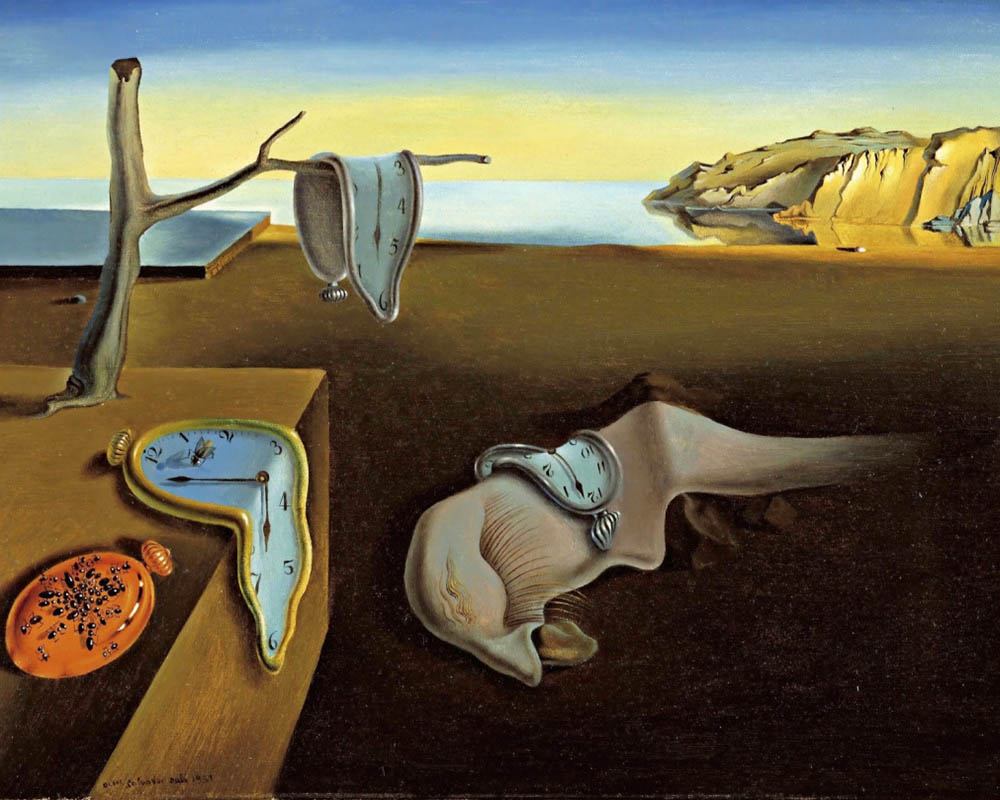
In fact, the soft watches draped over a branch and a sleeping figure in a desert landscape in “The Persistence of Memory” (1931) are rendered with the care of a Dutch Old Master. Every surface has texture. Every shadow falls correctly. The strangeness lives entirely in the logic of the objects, not in the execution. That combination, technical perfection holding an impossible idea, is what makes the painting so hard to dismiss.
Dream Caused by the Flight of a Bee
“Dream Caused by the Flight of a Bee Around a Pomegranate a Second Before Awakening” (1944) is one of the most cinematically constructed images in his catalog. A sleeping figure floats above a flat rock over the sea. From a pomegranate hovering in the air, a fish emerges, then a tiger leaping from the mouth of another tiger, then a rifle with a bayonet aimed at the sleeper’s arm. The entire chain is connected by the logic of a single bee sting about to happen.
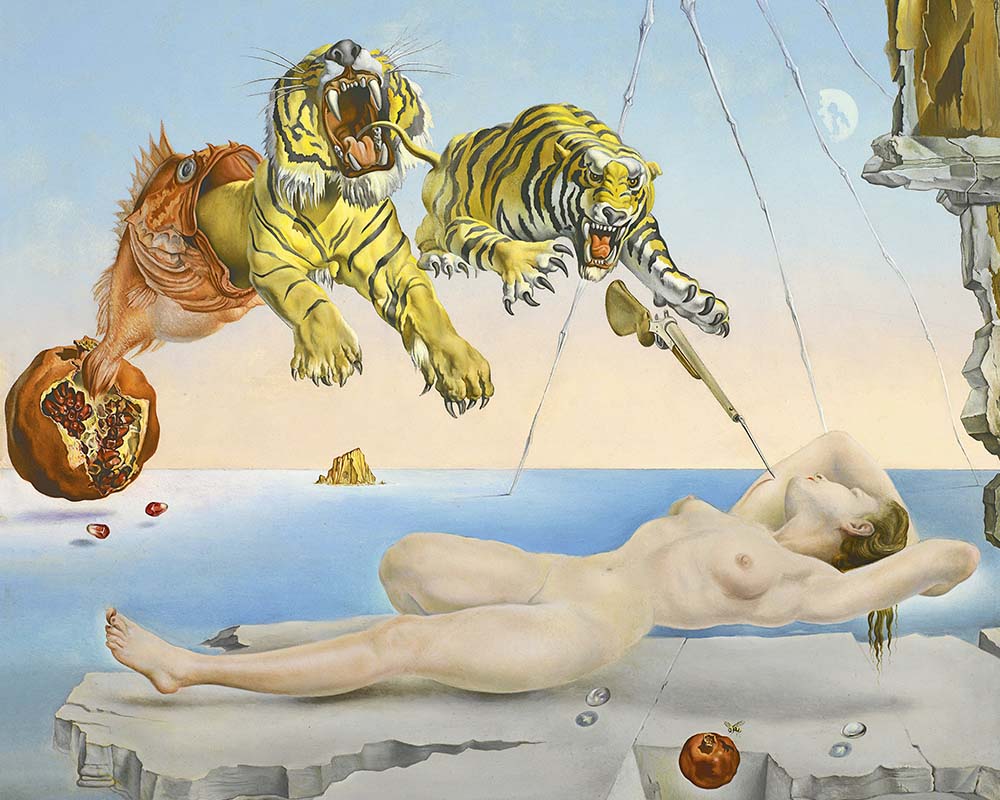
Indeed, what Dalí understood about dreams is that they have internal causality. They don’t just produce random images. They build sequences with their own compressed logic, and this painting is structured exactly the way a real dream is structured. Often, surrealist paintings feel like dreams from the outside. This one feels like being inside one.
The eccentric persona as artistic strategy
Dalí’s public persona, the flamboyant mustache, the theatrical pronouncements, the calculated outrage, was not separate from his art. It was an extension of it. He understood, decades before personal branding became a concept, that the artist’s image shapes how the work is received. By making himself into a spectacle, he guaranteed that his paintings would always be approached through a charged frame of reference.
His output was also genuinely multidisciplinary. Beyond the paintings, he eventually designed jewelry, collaborated with filmmakers, produced theater sets, and wrote. The work wasn’t confined to canvas. That restlessness is something I recognize and respect.
The Reminiscence and the range of Dalí’s surrealism
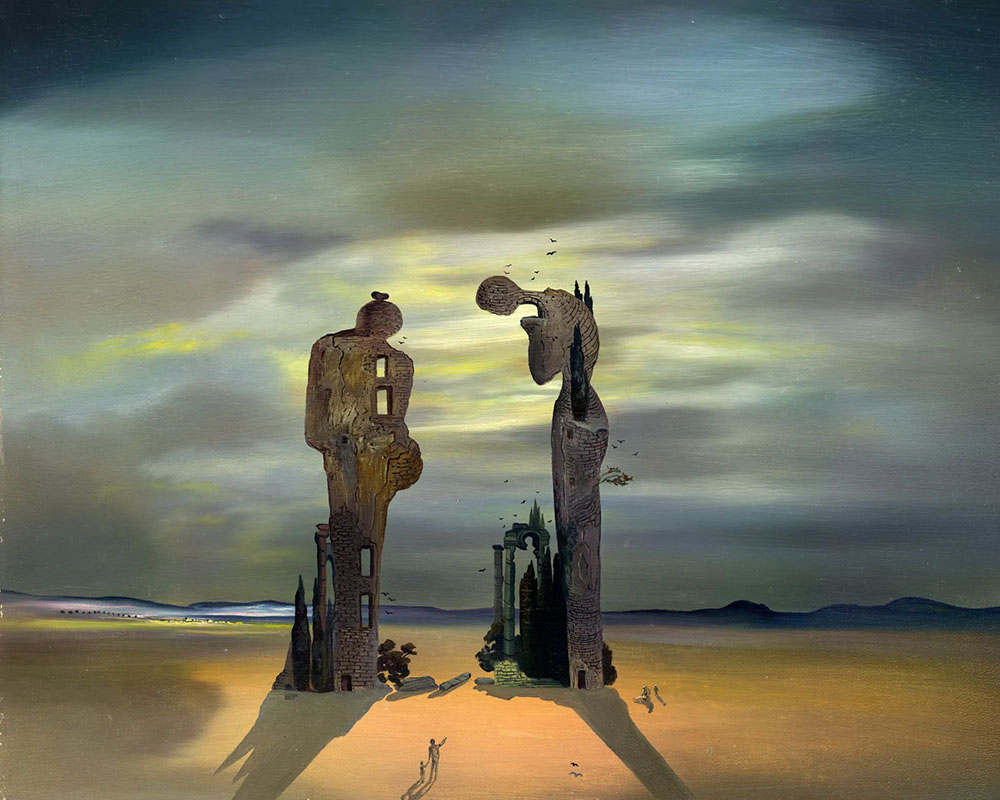
“Reminiscence of Millet’s Angelus” (1934) shows two monumental figures looming over a flat landscape, cast from the same composition as Millet’s famous painting. Dalí obsessively reinterpreted Millet’s Angelus across his career, seeing in it a latent violence he wanted to make visible. The figures in his version have a weight and stillness that reads as threatening rather than devotional.
His relationship to art history was always active, not reverential. Instead, he borrowed from the masters to destabilize them, not to pay homage. That approach, using shared visual memory as raw material for displacement, connects directly to what I wrote about in the René Magritte surrealism post. The two artists were working the same territory from completely different directions.
Why Salvador Dalí surrealism still holds up
Precision doesn’t age. The technique is impeccable, the questions are unresolved, and the images are still doing something to viewers that most paintings don’t. What is the relationship between a dream image and a waking one? How much does the mind impose its own logic onto what it perceives? Dalí’s paintings don’t answer those questions. They make you feel them, which is a different and harder thing.
His influence on what came after, including on my own surreal visions as an artist, isn’t about the melting clocks as a motif. It’s about the permission his work grants: to be technically rigorous and completely strange at the same time. The creative thinking books that shaped my practice kept returning to Dalí precisely for that reason.