
René Magritte surrealism: the vision that still unsettles
Magritte painted scenes that look completely normal until they don’t. Here’s what his surrealism is actually doing, and why it still gets under your skin.
share this!
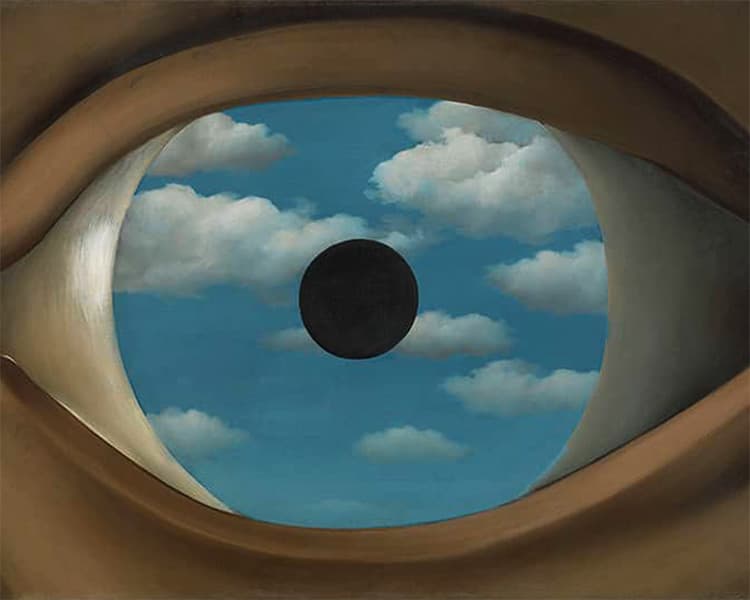
René Magritte surrealism occupies a category of its own. Born in 1898 in Lessines, Belgium, René Magritte spent most of his adult life in Brussels working in near-total obscurity before becoming one of the most recognizable painters of the twentieth century. Still, that trajectory matters. The domesticity of his life, the suburb, the suit, the bourgeois interior, wasn’t ironic background. It was the subject.
I first came across his work as a child and didn’t have the vocabulary to explain why it bothered me. Something was wrong in the pictures but I couldn’t locate where. That quality, the feeling of a scene that looks completely normal until it doesn’t, is what René Magritte surrealism is actually about.
Not dreams: what makes René Magritte surrealism different
Generally, most people group Magritte with Dalí and assume surrealism means melting clocks and subconscious imagery. Magritte’s version is colder and, I’d argue, more disturbing. He wasn’t painting dreams. Instead, he was painting the ordinary world with one element displaced just enough to make everything else feel unstable.
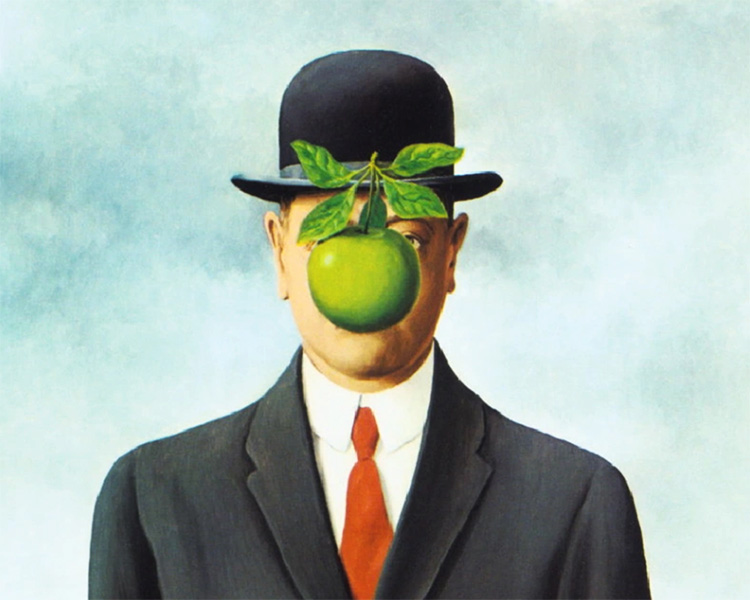
“The Son of Man” is a suited man in a bowler hat standing in front of a low wall, with the sea behind him. A green apple floats in front of his face. The painting is perfectly composed, lit like a Sunday afternoon. The wrongness is surgical. It doesn’t feel like a dream. It feels like a mistake you can’t find.
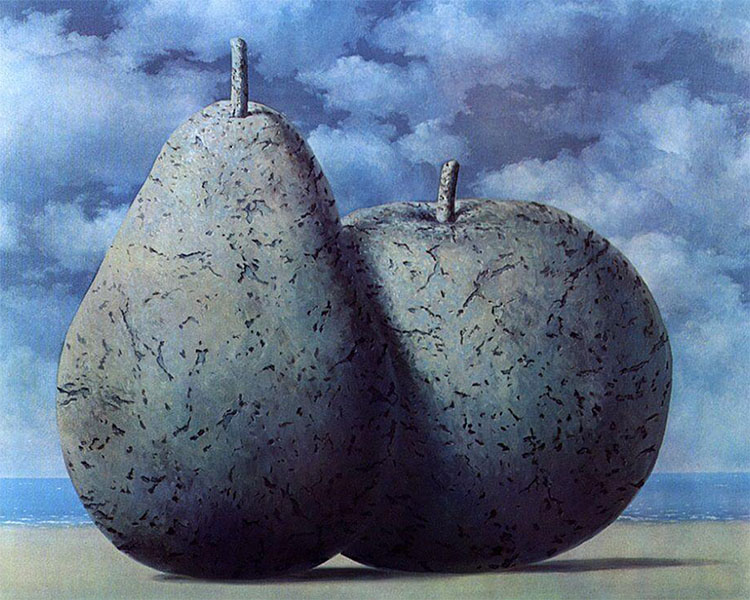
“Memory of a Voyage”, from 1955, takes a different approach to the same problem. A pear and an apple, rendered in stone, stand together on a beach under a cloudy sky. The forms are perfectly familiar: the silhouette, the stem, the proportions are all correct. What’s wrong is the material. They’re the size of boulders and the texture of granite, and yet they’re unmistakably fruit. Magritte keeps the shape intact and changes only what they’re made of, which turns out to be enough to make the whole image feel displaced. The ordinary survives. The ordinary is exactly what’s unsettling.
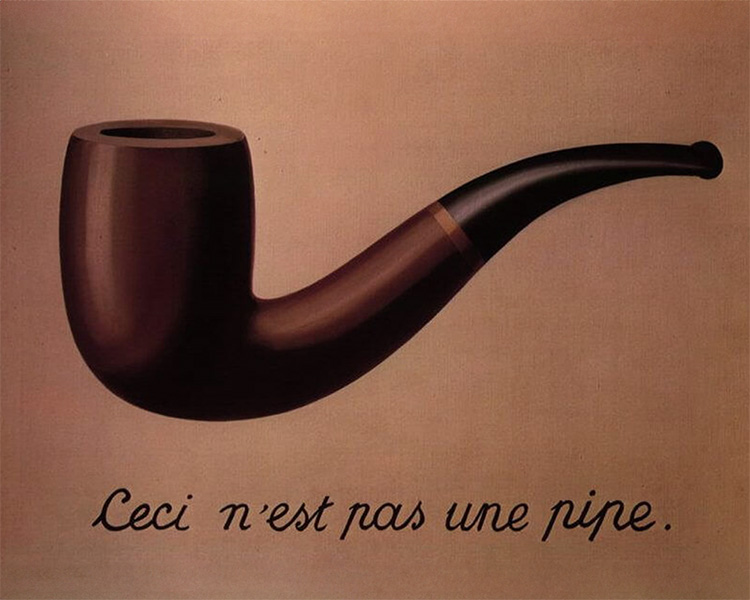
This is not a pipe
“The Treachery of Images”, painted in 1929, shows a pipe rendered with the precision of a technical illustration. Below it, in careful cursive: “Ceci n’est pas une pipe”. This is not a pipe.
The point isn’t wordplay. Rather, Magritte was making a precise argument: the image of a thing is not the thing itself. You can’t fill that painted pipe with tobacco. The representation and the reality are different objects, and we confuse them constantly. When I first understood what he was actually doing with that canvas, it reoriented how I think about images. A picture is always a translation, not a window, and working as an art director makes that distinction matter every single day.
Golconda and the serial uncanny
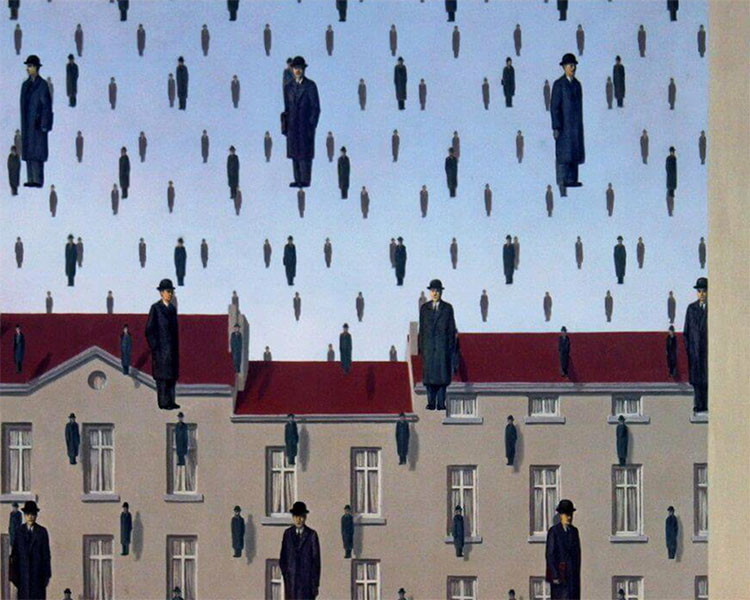
“Golconda”, from 1953, shows a sky filled with men in bowler hats and overcoats, falling or floating, suspended over a city of identical apartment buildings. There are enough of them to suggest a pattern, not enough to suggest an explanation.
Even so, what Magritte understood about repetition is that it doesn’t make things more familiar: it makes them stranger. One suited man is a character. In fact, dozens of identical suited men filling the sky is something else entirely. The painting uses the visual logic of a crowd to produce the effect of a hallucination, and it does it without anything technically surreal happening. The men are just there.
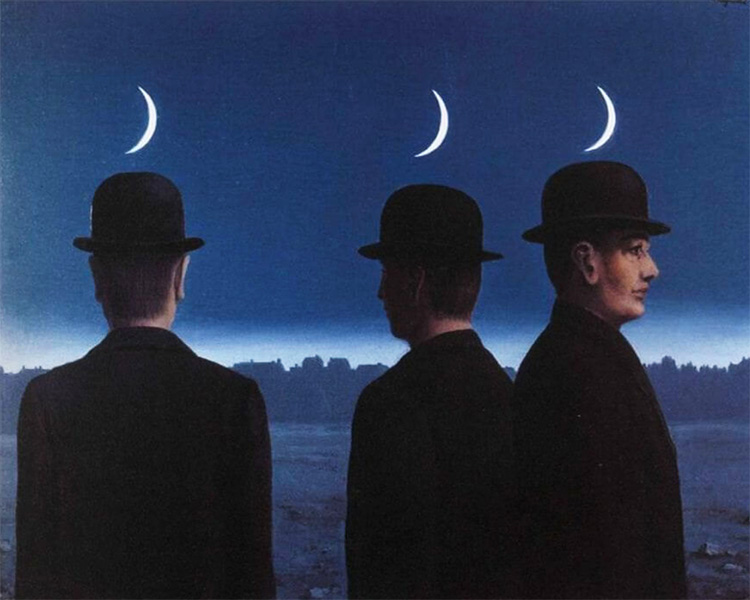
“The Mysteries of the Horizon”, also from 1955, takes the same logic further. Three men in bowler hats stand facing away from us, and behind each one hangs a different moon, each full, each at a different position in the sky. The scene is twilight-quiet. Three moons for three men, and no one seems to find that remarkable. What makes it unsettling isn’t the impossibility itself, it’s the indifference to it. Magritte keeps returning to that particular quality: the world behaving wrongly, with no one in the painting registering it as wrong.
Why René Magritte surrealism still holds up
Magritte’s paintings hold up because the questions they ask haven’t been answered. What is the relationship between an image and what it depicts? When does the familiar start to feel like a threat? Those questions are, in fact, more pressing now than they were in 1929. Nevertheless, we live inside images in a way Magritte couldn’t have anticipated, and his work remains one of the clearest demonstrations of why that’s worth paying attention to.
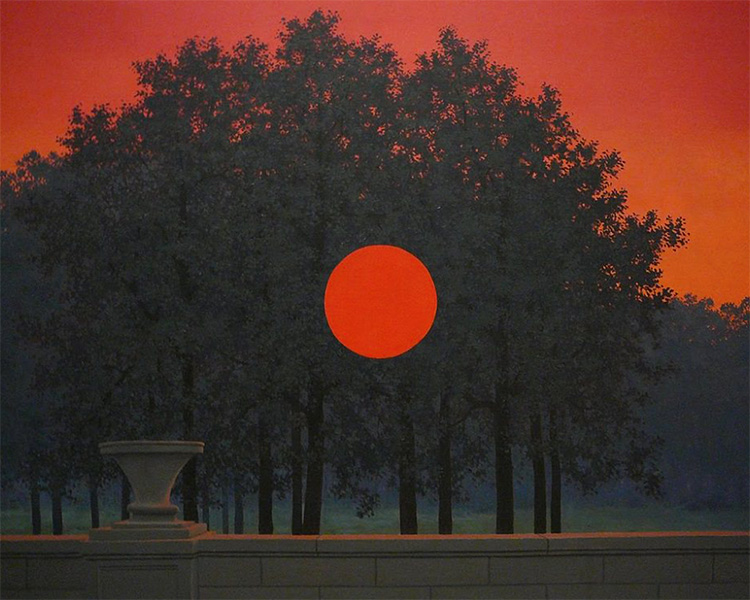
“The Banquet,” from 1958, is the most outwardly peaceful image in his catalog: a row of trees at dusk, a terrace wall, a warm red sky. No floating figures, no impossible scale. Then you notice the sun. It sits in front of the trees, not behind them. A solid red disc hovering between the trunks and the viewer, obeying no physics that apply anywhere else. Magritte doesn’t announce it. The scene is completely calm. The wrongness is just there, waiting for you to find it.
The unease in René Magritte surrealism doesn’t have an expiration date. Work built on ideas lasts longer than work built on style, and Magritte knew exactly which one he was making.